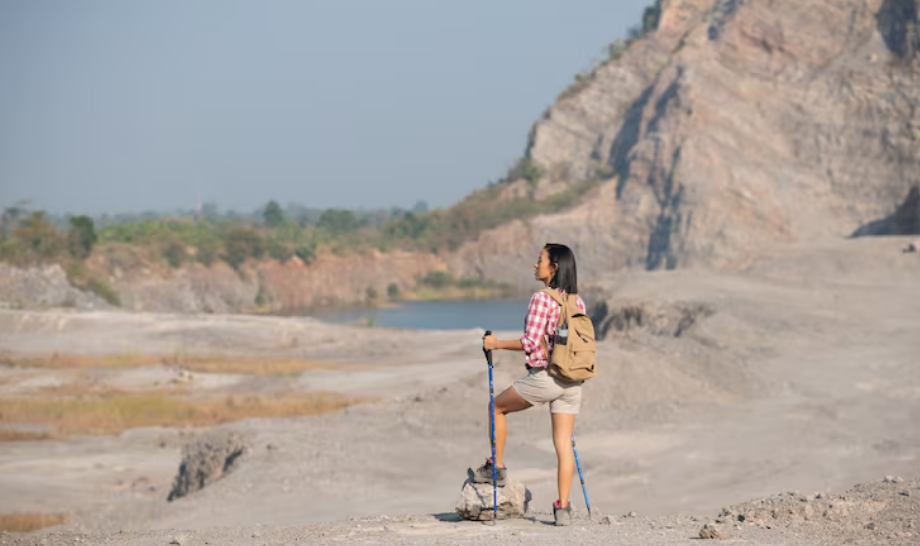
I had seen pictures of Dholavira before visiting, but they did not adequately prepare me for the site’s surroundings. The ruins are dispersed around Kutch’s desolate landscape, and at first glance, one is tempted to question what might still be there after thousands of years.
From a distance, what appeared to be a collection of stones gradually transformed into walls, streets, reservoirs, and thoughtfully designed areas of an ancient community. I noticed that I was slowing down, trying to picture this location as a real metropolis instead of an archaeological site.
The Dholavira ruins were much more organised than I expected
The planning at Dholavira was the first thing that caught me off guard. The archaeological remains represented the Harappan civilisation. The settlement was inhabited for a very long time, with its most significant periods occurring during the third and second millennia BCE.
The city’s organisation became more and more clear as I started to observe it even more closely. A very well-planned settlement was suggested by the clearly defined spaces, walls, streets, and buildings. It was hard not to think of the remnants as chaotic, makeshift remnants of an ancient city. Rather, Dholavira felt well-considered.
The water reservoirs of Dholavira fascinated me most
The water-management system was the area of the ruins that most captivated me. Dholavira featured several channels and reservoirs intended to gather and hold water. It was especially amazing to discover this smart handling of water in an area that is currently surrounded by such arid terrain.
I kept thinking about the real-world issue that these locals had to deal with. The city was built with the collection and conservation of water in mind because it could not be taken for granted. Additionally noteworthy were the stone-lined ponds, which gave the ancient settlement a much more historic feel. This culture had to invent mechanisms for daily life as well as create magnificent artefacts.
I kept noticing Dholavira’s details in the stone
As I moved around the site, I started to focus more on the actual construction. The remnants of its walls and foundations showed how carefully it was built. There were various parts of the city, such as the middle and lower town regions and what archaeologists refer to as the citadel.
At first, it was hard to understand the scale. I had to imagine the city using the foundations and remaining structures. In fact, that increased my engagement. I had to envision the missing bits while staring at the ruins instead of a full picture.
The famous signboard was another surprise in Dholavira
The discovery of a sizable signboard written in Indus script at the location was one of the things that stopped me. The signs and inscriptions from Harappan ruins are particularly fascinating because the Indus script is still incomprehensible. It is thought that the big sign at Dholavira previously had ten symbols.
As I stood there, I was intrigued by its archaeological history. A whole written language has still not been definitively deciphered, despite us knowing the city’s planning, construction, and water systems.
I left Dholavira with more questions than answers
I think that was my favourite aspect of the trip. I expected old ruins when I travelled to Dholavira. As I departed, I thought about the people who built the city, oversaw its water supply, conducted business with far-off places, and led regular lives inside those walls.
Dholavira made the vast amount of knowledge we still need about the Harappan society seem intriguing. It reminded us that an archaeological site need not feature imposing monuments or standing temples to be exceptional. Sometimes you can learn just as much from a line of stones, a reservoir, or a foundation.
Final thoughts
My trip to Dholavira ended up being more about experiencing the civilisation behind the ruins than simply viewing them. I was reminded of the lengthy journey through Kutch, the meticulously built community, the massive reservoirs, and the enigma surrounding the Indus script. What most fascinated me was the contrast between Dholavira’s current surroundings and the intricacy of the metropolis that once existed there. Staying at one of the hotels in Kutch also made Dholavira easier to plan around.
Instead of considering the site as a quick stop, I would give it lots of time. Take a stroll, observe the construction details, and spend some time just admiring the scenery. The more I studied those ancient ruins, the more amazing they seemed.