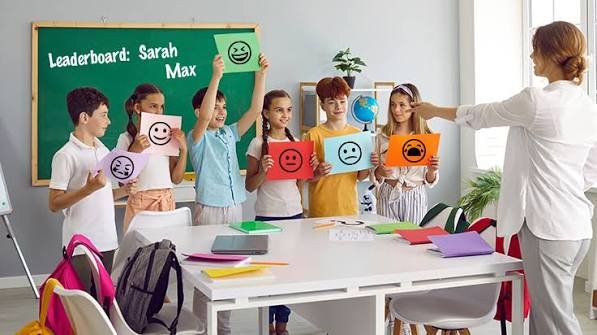
Gamification in education is the use of game-like elements in teaching and learning to make educational activities more engaging, interactive, and motivating. It involves incorporating features such as points, badges, levels, challenges, leaderboards, rewards, and progress tracking into lessons or educational activities. The purpose is to encourage students to participate actively, practice important skills, and work toward learning goals.
Unlike learning through video games alone, gamification can be used in traditional classrooms, online courses, homeschooling, educational apps, and workplace training. For example, a teacher might award points for completing mathematics exercises, introduce levels for mastering vocabulary, or use team challenges to help students understand science concepts.
Gamification in education does not mean turning every lesson into a game. Instead, it uses selected game mechanics to support educational objectives. When implemented effectively, it can encourage participation, provide immediate feedback, make progress visible, and help learners develop persistence.
However, successful gamification requires more than rewards and competition. Activities must be connected to meaningful learning outcomes, appropriate for students’ ages and abilities, and designed to encourage understanding rather than simply collecting points.
Key Takeaways About Gamification in Education
- Gamification uses game-like features to support teaching and learning.
- Common elements include points, badges, levels, challenges, rewards, and progress bars.
- It can improve engagement, participation, motivation, and opportunities for practice.
- Teachers can use gamification in classrooms, online learning platforms, and educational apps.
- Examples include quizzes, classroom missions, vocabulary challenges, and mathematics competitions.
- Effective gamification focuses on learning outcomes rather than rewards alone.
- Poorly designed systems can create unhealthy competition, distraction, or excessive pressure.
How Does Gamification Work in Education?
Gamification works by incorporating motivational elements commonly found in games into educational experiences. Students receive clear goals, opportunities to practice, feedback about their performance, and visible signs of progress.
For example, a teacher may divide a science unit into five learning levels. Students complete activities about ecosystems, food chains, habitats, and biodiversity. Each completed activity unlocks the next challenge, while feedback explains which concepts students understand and which require more practice.
The process generally involves several steps.
1. Set a learning objective. The teacher identifies what students should learn, such as solving equations, improving reading comprehension, or understanding historical events.
2. Choose suitable game elements. Points, badges, levels, missions, or collaborative challenges are selected to support the objective.
3. Give students meaningful challenges. Activities should be achievable but require effort, reasoning, and practice.
4. Provide feedback. Students receive information about their answers, progress, and areas for improvement.
5. Track learning progress. Teachers and students review completed tasks and identify concepts that need additional attention.
6. Connect rewards to learning. Recognition should reflect effort, improvement, collaboration, or demonstrated mastery instead of rewarding speed alone.
This approach helps make learning more interactive while keeping the educational objective at the center of the activity.
What Are the Main Elements of Gamification in Education?
Several game mechanics are commonly used in educational environments. Teachers can combine them or choose only a few based on their students’ needs.
| Gamification element | How it works | Educational example |
|---|---|---|
| Points | Students earn points for completing tasks or demonstrating skills | Award points for correctly solving mathematics problems |
| Badges | Students receive recognition for achievements | Give a reading badge after completing a set of books |
| Levels | Activities progress from basic to advanced | Introduce increasingly difficult grammar exercises |
| Leaderboards | Students see rankings based on selected achievements | Display team scores during a revision activity |
| Challenges | Learners work toward a specific goal | Complete a weekly science investigation |
| Rewards | Students receive recognition or privileges | Offer a choice of classroom activity after a milestone |
| Progress bars | Learners can see how far they have progressed | Track completion of an online course |
| Quests and missions | Learning is organized around a sequence of tasks | Solve clues to uncover facts about ancient civilizations |
| Instant feedback | Students receive immediate information about performance | Show explanations after each quiz question |
| Team collaboration | Students work together toward a shared goal | Earn a class reward by completing a group project |
Not every element is equally suitable for every learner. For instance, leaderboards may motivate some students but discourage others. Collaborative goals, personal progress tracking, and opportunities to retry can provide motivation without placing too much emphasis on competition.
What Are the Benefits of Gamification in Education?
Gamification can support learning when activities are carefully designed and aligned with educational objectives. Its effectiveness depends on the students, subject, teaching methods, and implementation.
1. Increases Student Engagement
One major benefit of gamification is that it can make lessons more interactive. Instead of only listening to explanations or completing repetitive worksheets, students may participate in quizzes, missions, puzzles, and collaborative challenges.
These activities provide opportunities to make decisions, solve problems, and apply knowledge. For example, a geography lesson might ask students to identify countries through clues and gradually unlock more difficult questions.
Interactive tasks can help capture attention, especially when students understand the purpose of each activity and receive useful feedback.
2. Improves Motivation
Game-like features can give students clear goals and visible evidence of progress. Earning a badge, reaching a new level, or completing a challenge may encourage learners to continue practicing.
However, motivation can come from different sources. Some students enjoy competition, while others prefer personal achievement, collaboration, or solving difficult problems. Effective gamification provides several ways to experience success.
Teachers should also help students recognize the value of learning itself. If students participate only to earn points, they may lose interest when rewards disappear.
3. Provides Immediate Feedback
Many gamified activities tell students whether an answer is correct and explain why. This allows learners to recognize mistakes while the material is still fresh in their minds.
For example, a digital mathematics quiz can show the correct method after an incorrect answer. Students can then try a similar problem and check whether they understand the concept.
Immediate feedback can help teachers identify common misconceptions and adjust instruction before moving to more advanced material.
4. Encourages Repeated Practice
Students often need to practice a skill several times before mastering it. Gamification can make repetition more engaging by presenting the same underlying skill through different challenges.
Language learners might complete vocabulary rounds, matching exercises, spelling missions, and sentence-building activities. Mathematics students might solve progressively harder problems and earn recognition for demonstrating accuracy.
Repeated practice is most useful when tasks strengthen understanding rather than simply require students to repeat answers mechanically.
5. Supports Different Learning Needs
Gamification can offer multiple ways for students to participate. Some learners may prefer visual progress indicators, while others may enjoy puzzles, written challenges, teamwork, or independent activities.
Teachers can also provide different difficulty levels, additional attempts, hints, and alternative ways to demonstrate mastery.
These options can make learning more flexible. Nevertheless, gamification is not automatically accessible to every student. Activities must account for disabilities, language differences, technology access, and individual learning needs.
6. Develops Problem-Solving Skills
Challenges, simulations, and educational missions can encourage students to analyze information, test ideas, and make decisions.
For example, a classroom activity about environmental science might ask teams to design a sustainable city while balancing energy use, transportation, waste management, and available resources.
Students must apply what they have learned, evaluate alternatives, and explain their decisions. Such activities can help connect theoretical knowledge with practical problem-solving.
7. Encourages Collaboration
Not all gamification needs to involve individual scores. Team challenges allow students to share ideas, divide responsibilities, and work toward common goals.
A history class might organize a group investigation in which each team studies a different historical source before presenting its findings. Students earn recognition for accurate research, cooperation, and clear explanations.
Collaborative gamification can also help learners practice communication and conflict resolution, provided that every student has a meaningful role.
What Are Examples of Gamification in Education?
Gamification can be used across different subjects and grade levels. The following examples demonstrate how teachers can connect game mechanics to real learning goals.
Gamification in Mathematics
A teacher can create a mathematics mission in which students solve equations to unlock successive stages. Early questions may focus on basic calculations, while later tasks require multi-step reasoning.
Students earn progress points for correct solutions and receive explanations when they make mistakes. Rather than rewarding only the fastest student, the teacher can recognize improvement, accuracy, and the ability to explain a solution.
Gamification in Language Learning
Language teachers can use vocabulary quests, spelling challenges, grammar levels, and conversation missions.
For example, students may earn a vocabulary badge after correctly using a set of new words in sentences. A more advanced challenge might require them to write a short story using the same vocabulary.
This method connects practice with real language use instead of limiting progress to memorizing isolated words.
Gamification in Science
Science lessons can include investigations, virtual experiments, prediction challenges, and problem-solving missions.
Students might investigate which materials provide the best insulation, record their results, and earn recognition for careful observation and evidence-based explanations.
The game element should reward scientific thinking, not just guessing the correct answer.
Gamification in History
A history teacher might create a historical investigation in which students examine clues, timelines, maps, and primary sources to understand an event.
Each completed activity reveals another piece of evidence. Students then prepare an explanation supported by the information they have collected.
This approach can encourage historical reasoning while helping students distinguish evidence from assumptions.
Gamification in Online Learning
Digital learning platforms can use quizzes, badges, progress dashboards, streaks, and course milestones to encourage regular study.
Students may complete short lessons, answer questions, receive feedback, and track their progress toward a course goal.
Online gamification works best when the digital features help students understand difficult material and maintain steady progress. Notifications and rewards should not distract learners from the actual content.
What Is the Difference Between Gamification and Game-Based Learning?
Gamification and game-based learning are closely related, but they are not the same.
Gamification adds selected game elements to an activity that is not necessarily a game. Game-based learning uses an actual game as the central learning experience.
| Feature | Gamification | Game-based learning |
|---|---|---|
| Main approach | Adds game mechanics to learning activities | Uses games to teach or reinforce concepts |
| Typical example | Awarding badges for completing reading tasks | Playing a simulation to understand an ecosystem |
| Learning structure | Often follows a conventional lesson or course | Learning takes place through gameplay |
| Common elements | Points, levels, rewards, progress tracking | Rules, objectives, decisions, challenges, game scenarios |
| Teacher’s role | Connects game mechanics to lesson objectives | Selects or designs games that teach specific concepts |
| Assessment | May include quizzes, assignments, and progress indicators | May assess decisions, strategies, outcomes, and understanding |
Both approaches can support education. The best choice depends on the learning objective, available resources, student age, and the kind of experience the teacher wants to create.
How Can Teachers Implement Gamification in the Classroom?
Teachers do not need expensive software or advanced technical skills to introduce gamification. A simple, well-planned activity can be effective.
Step 1: Identify the learning goal. Decide whether the activity should improve reading comprehension, reinforce vocabulary, develop mathematical reasoning, or assess understanding of a topic.
Step 2: Select an appropriate game mechanic. Choose a quiz, team challenge, progress chart, set of levels, or achievement badge that supports the objective.
Step 3: Explain the rules clearly. Students should understand how to participate, what counts as success, and how the activity connects to the lesson.
Step 4: Make the challenge achievable. Start with tasks that students can complete with reasonable effort, then gradually increase complexity.
Step 5: Provide feedback and opportunities to retry. Mistakes should help students learn. Offer hints, explanations, and additional attempts when appropriate.
Step 6: Include different forms of achievement. Recognize persistence, improvement, creativity, collaboration, and mastery, rather than rewarding only the highest score.
Step 7: Evaluate the results. Check whether students have actually learned the intended material. A fun activity is not necessarily an effective learning activity if it fails to improve understanding.
What Are the Challenges of Gamification in Education?
Although gamification offers potential benefits, it also has limitations that teachers should consider.
Excessive Focus on Rewards
If students care only about points, prizes, or badges, they may complete activities without understanding the content. Teachers should use rewards carefully and emphasize the satisfaction of solving problems, developing skills, and achieving meaningful goals.
Unhealthy Competition
Leaderboards can motivate some students but cause anxiety or embarrassment for others, particularly when the same learners consistently appear at the bottom.
Personal progress charts, team-based goals, and private feedback can reduce these problems. Students should have opportunities to improve without being publicly compared with their classmates.
Distraction From Learning Objectives
Elaborate stories, animations, and reward systems can consume time without improving learning. Game mechanics should support the subject rather than become the main attraction.
Technology and Accessibility Barriers
Digital gamification may require reliable internet access, devices, or paid subscriptions. Students may not have equal access to these resources.
Teachers can use low-cost, offline alternatives such as paper-based quizzes, classroom missions, physical cards, and team challenges. Digital activities should also accommodate students who need assistive technology or alternative formats.
Time and Planning Requirements
Creating meaningful gamified lessons can require preparation. Teachers need to design appropriate challenges, check the accuracy of content, prepare feedback, and monitor learning.
Starting with one simple activity and improving it over time can make implementation more manageable.
What Tools Can Be Used for Gamification in Education?
Teachers can use digital platforms or simple classroom materials to create gamified experiences. The appropriate tool depends on the students’ ages, subject, privacy requirements, budget, and available technology.
| Tool or resource | Potential educational use |
|---|---|
| Online quiz platforms | Interactive quizzes and knowledge checks |
| Learning management systems | Course progress, completion tracking, and achievements |
| Digital flashcards | Vocabulary practice and repeated review |
| Classroom reward charts | Recognizing effort, improvement, and participation |
| Interactive presentations | Branching questions, missions, and classroom challenges |
| Educational simulations | Exploring systems, decisions, and cause-and-effect relationships |
| Paper-based game materials | Offline puzzles, card games, and team activities |
Before selecting a digital platform, teachers should review student privacy policies, accessibility features, cost, advertising, and whether the tool works with school devices. Technology should make learning easier to manage and understand, not create unnecessary barriers.
How Can Gamification Be Used in Different Age Groups?
Gamification should match students’ developmental levels and educational needs.
For younger children, simple storytelling, picture-based challenges, cooperative activities, and immediate feedback can make lessons more engaging. Rewards should be understandable and should not overshadow curiosity or exploration.
For primary and middle school students, teachers can introduce learning levels, subject-based missions, team challenges, and progress tracking. These features can support regular practice and help learners see how their skills develop.
For secondary school students, more complex activities may include simulations, research quests, debate challenges, and collaborative problem-solving tasks. Students can take greater responsibility for planning their progress and evaluating their performance.
For college students and adult learners, gamification may involve professional simulations, scenario-based assessments, achievement milestones, and collaborative projects. In these settings, challenges should be relevant to academic or professional goals.
Across all age groups, teachers should prioritize meaningful learning, fair participation, and constructive feedback.
Frequently Asked Questions About Gamification in Education
What is gamification in education in simple words?
Gamification in education means using game-like features, such as points, badges, challenges, levels, and rewards, to make learning activities more interactive and motivating. The goal is to help students engage with lessons and achieve specific educational objectives.
What are the main elements of gamification in education?
Common elements include points, badges, leaderboards, levels, challenges, progress bars, rewards, missions, and immediate feedback. Teachers choose elements that support the lesson and suit students’ needs.
What is an example of gamification in education?
An example is a mathematics class in which students complete progressively difficult problems to unlock new levels. Students receive feedback on their answers and recognition for improvement and mastery. The game structure encourages practice while supporting the mathematics learning objective.
What is the difference between gamification and game-based learning?
Gamification adds game-like elements to an existing learning activity, such as awarding badges for completing assignments. Game-based learning uses an actual game or simulation as the primary method for teaching or practicing a concept.
Does gamification improve student learning?
Gamification can support engagement, practice, and feedback, but its effect on learning depends on how it is designed and implemented. Activities are more useful when they align with clear educational goals, provide meaningful feedback, and assess actual understanding rather than participation alone.
Conclusion
Gamification in education is an approach that incorporates game-like features into teaching and learning to encourage engagement, motivation, practice, and progress. Points, badges, levels, challenges, team missions, and feedback systems can help teachers make educational activities more interactive and give students a clearer understanding of their development.
Its applications range from mathematics quizzes and language-learning challenges to science investigations, history activities, and online courses. However, successful gamification requires thoughtful planning, appropriate challenges, accessibility, and a strong connection between game mechanics and learning outcomes.
The most effective approach is not to make every lesson competitive or reward-driven. Instead, teachers should use game elements to support curiosity, persistence, collaboration, and genuine understanding. When learning remains the priority, gamification can become a useful addition to a balanced educational strategy.